
Selecting the right Ptfe Elgiloy Lip Seal manufacturer requires more than comparing catalog prices. It requires evidence.
These seals combine PTFE’s low friction with Elgiloy’s corrosion resistance and spring resilience. That combination supports demanding pumps, actuators, aerospace equipment, chemical systems, and high-cycle machinery. However, performance depends on more than material names. Shaft finish, pressure direction, temperature changes, lubrication, installation quality, and storage conditions can alter results.
This guide examines ten leading Ptfe Elgiloy Lip Seal manufacturers worldwide. The comparison considers manufacturing experience, material traceability, engineering support, testing practices, customization, quality systems, and delivery capability. It also considers whether a supplier can explain failure modes clearly, not merely promote impressive specifications.
Robert M. Flitney, a respected sealing author and engineer, is often associated with the practical reminder: “A seal is only as good as the system in which it operates.” That principle remains useful here. A technically excellent lip seal may still fail inside a poorly aligned assembly.
Small details matter.
A polished shaft can look perfect yet create excessive leakage when its hardness is unsuitable. A spring can resist corrosion but lose effectiveness after repeated thermal cycling. Some manufacturers publish extensive data. Others provide limited evidence, which deserves careful questioning.
This ranking is therefore not an absolute verdict. It is a practical starting point for engineers, buyers, and maintenance teams. Readers should verify current certifications, test conditions, lead times, and compatibility before selecting a supplier. Performance claims need context. Even this article may overlook regional strengths or emerging specialists. That limitation is worth acknowledging.
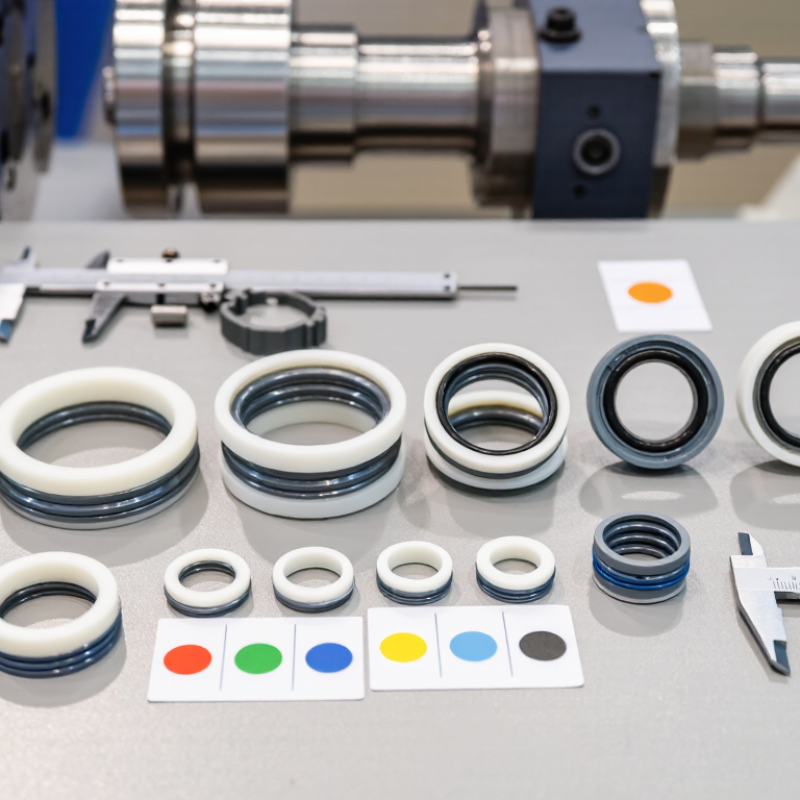
PTFE Elgiloy lip seals combine a low-friction polymer lip with a corrosion-resistant cobalt alloy energizer. The PTFE element contacts the shaft and limits fluid leakage during rotation. Its lip geometry controls contact pressure along a narrow sealing line. The Elgiloy spring maintains that pressure when temperature, speed, or shaft position changes.
Material selection affects performance strongly. Filled PTFE grades can improve wear resistance and reduce deformation under pressure. However, fillers may increase shaft wear if the surface finish is unsuitable. The Elgiloy energizer tolerates moisture, chemicals, and repeated temperature changes better than many common spring alloys. A practical design still needs the correct hardness and compatibility data.
Installation details often decide service life. A smooth shaft, controlled runout, and clean housing help the lip seat evenly. Excessive pressure can force PTFE into the clearance gap, especially during startup. That weakness deserves attention. Manufacturers should verify lip dimensions, alloy composition, spring load, and batch traceability. Pressure cycling and thermal testing provide more useful evidence than catalog ratings alone. In field inspections, uneven wear marks often reveal misalignment rather than defective material. Even a well-designed seal can fail when assembly tools scratch the lip.
Evaluating global PTFE Elgiloy lip seal manufacturers requires more than comparing unit prices. Start with material control. The supplier should provide heat numbers, alloy certificates, PTFE grade records, and dimensional inspection results. Elgiloy reinforcement needs stable chemistry and hardness, especially under vibration and repeated thermal cycling. ISO 9001 certification supports process discipline, but it does not prove sealing performance.
Testing evidence matters more. Request leakage, friction, pressure, and temperature data from production samples. ASTM F37 methods can support fluid leakage evaluation, while application-specific testing should reflect real shaft speed and media. A 2023 Grand View Research report estimated the global PTFE market at approximately US$3 billion. That scale suggests broad availability, yet market size says little about lip-seal consistency. It is only context.
Look for documented capability at tight tolerances, controlled molding, clean packaging, and batch traceability. According to ISO 2859-1 principles, sampling plans should be defined rather than improvised during inspection. Ask for process capability data, corrective-action records, and independent audit results. Technical experience should be visible in failure analysis, not only in brochures. A strong manufacturer can explain wear patterns, compression set, and Elgiloy fatigue behavior with measured evidence.
Supply reliability also deserves scrutiny. Evaluate capacity, backup tooling, raw-material continuity, and realistic lead times. Some suppliers publish impressive test curves. Few disclose test fixtures or sample conditioning. That gap needs questioning. Price comparisons can mislead, because cheaper seals may increase maintenance through early leakage. The difficult part is separating genuine engineering depth from polished documentation. Even experienced buyers can overvalue certificates and undervalue field history.
This 100-point evaluation framework emphasizes the factors most relevant to PTFE and Elgiloy lip seal sourcing: sealing performance, material traceability, operating-temperature and chemical compatibility, quality systems, production capacity, validation documentation, and delivery reliability. It is a supplier-assessment model rather than a ranking of individual companies.
The leading PTFE Elgiloy lip seal manufacturers differ in engineering depth and production focus. One specializes in custom seals for chemical pumps, using precision-machined grooves and documented dimensional checks. Another serves hydraulic equipment, emphasizing low friction during repeated rod movement. A third operates strong cleanroom controls for pharmaceutical applications. Its technicians inspect seal lips under magnification. A fourth combines PTFE compounds with corrosion-resistant Elgiloy springs for aggressive fluids. A fifth is known for rapid prototyping, producing trial parts before full production. That reduces costly tooling errors.
The remaining profiles reveal other practical strengths. One manufacturer supports high-temperature aerospace assemblies with batch-level material traceability. Another focuses on large-diameter seals for industrial valves, where uneven compression can cause leakage. A specialist in food-processing equipment prioritizes smooth surfaces and washable designs. One supplier offers global technical support, helping engineers verify pressure, speed, and temperature limits. The tenth combines automated molding with manual finishing for difficult geometries. Automation improves consistency, but it cannot replace experienced inspection. No manufacturer performs perfectly across every application. Buyers should question vague test claims, request material certificates, and review actual service data. A seal that survives a bench test may still fail after installation errors, shaft damage, or unexpected chemical exposure.
Top 10 PTFE Lip Seal Manufacturers Worldwide
Leading PTFE lip seal manufacturers differ in production depth, certification control, and regional service coverage. Their facilities should handle precision molding, machining, spring forming, and controlled assembly. For demanding applications, cobalt-based high-strength alloy energizers can improve resilience under heat, pressure, and chemical exposure.
Experienced manufacturers provide dimensional inspection reports, material certificates, and batch traceability. Look for documented testing at operating temperature, shaft speed, pressure, and media conditions. ISO 9001 certification supports process consistency, but it does not guarantee seal performance in every installation. Ask for application data.
Manufacturing capacity matters when orders increase. Some suppliers support prototypes in small batches, while others operate automated lines for global programs. Market coverage should include responsive engineering teams, local inventory, and clear export documentation. A capable supplier can explain lead times without hiding behind vague estimates.
Reality is less polished. Public certification records may be outdated. Test methods may vary between factories. Even experienced engineers can overlook shaft finish or installation damage. A reliable comparison should examine audit results, failure analysis, and customer references, not only catalog claims. Small details often decide service life.
| Rank | Manufacturer ID | PTFE Seal Materials | Elgiloy Compatibility | Manufacturing Capabilities | Typical Temperature Range | Key Certifications | Validation and Testing | Primary Market Coverage | Production Profile |
|---|---|---|---|---|---|---|---|---|---|
| 1 | Manufacturer 01 | Virgin and filled PTFE; carbon, glass-fiber, graphite, and bronze-filled grades | Spring-energized designs using Elgiloy alloy springs for corrosive and high-cycle service | CNC turning, precision lip forming, spring insertion, clean assembly, custom cross-sections | Approximately −60°C to 260°C, application dependent | ISO 9001; selected aerospace and medical programs may require additional approvals | Dimensional inspection, leakage testing, friction testing, material traceability | North America, Europe, Asia-Pacific, and the Middle East | High-volume production with engineered-to-order support |
| 2 | Manufacturer 02 | Virgin PTFE, modified PTFE, and low-friction filled compounds | Elgiloy spring energizers available for chemical, vacuum, and reciprocating applications | Molded blanks, CNC machining, automated spring loading, low-volume prototyping | Approximately −50°C to 250°C, design dependent | ISO 9001; customer-specific aerospace quality systems | Pressure decay, helium leak, surface-finish, and dimensional capability studies | Europe, North America, and selected Asian export markets | Medium-to-high volume with rapid customization |
| 3 | Manufacturer 03 | Virgin PTFE and FDA-oriented grades; conductive and wear-resistant compounds | Elgiloy energizers for dynamic sealing and aggressive media environments | Precision machining, micro-seal production, automated inspection, batch traceability | Approximately −40°C to 260°C, depending on compound and hardware | ISO 9001; ISO 13485 available for qualified medical production lines | Particle control, leakage, compression, friction, and biocompatibility documentation where required | North America, Europe, Japan, South Korea, and Southeast Asia | Specialty production focused on medical and analytical equipment |
| 4 | Manufacturer 04 | Carbon-filled, graphite-filled, glass-filled, and chemically modified PTFE | Elgiloy spring systems for high-pressure hydraulic and process equipment | Compression molding, isostatic molding, CNC finishing, assembly, and application engineering | Approximately −60°C to 230°C, based on operating medium | ISO 9001; ISO 14001 commonly integrated into production operations | Pressure cycling, wear testing, chemical compatibility, and metallurgical verification | Europe, North America, Latin America, and Gulf-region markets | Industrial and energy-sector production |
| 5 | Manufacturer 05 | Virgin PTFE, low-friction PTFE blends, and high-wear formulations | Elgiloy energizers offered for rotary, reciprocating, and static sealing | CNC machining, thin-wall lip seals, small-diameter production, prototype tooling | Approximately −55°C to 260°C, application dependent | ISO 9001; sector-specific customer approvals | Dimensional reports, friction-torque testing, pressure testing, and visual inspection | Asia-Pacific, Europe, North America, and Australia | Flexible batch manufacturing and aftermarket supply |
| 6 | Manufacturer 06 | Modified PTFE, carbon-filled PTFE, and electrically conductive grades | Elgiloy spring energizers for vacuum, semiconductor, and chemical-processing service | Cleanroom-compatible machining, precision groove control, spring forming, special packaging | Approximately −70°C to 250°C, depending on seal design | ISO 9001; clean manufacturing controls documented by customer requirement | Helium leak testing, particle monitoring, surface roughness, and lot release inspection | East Asia, North America, Europe, and Singapore-based supply chains | High-mix, low-to-medium volume precision production |
| 7 | Manufacturer 07 | Virgin PTFE, glass-filled PTFE, bronze-filled PTFE, and wear-resistant blends | Elgiloy spring options for pumps, valves, compressors, and hydraulic systems | Molded and machined seals, automated measurement, assembly, and repair kits | Approximately −50°C to 230°C, medium and pressure dependent | ISO 9001; environmental management practices aligned with ISO 14001 | Pressure, temperature, wear, chemical-resistance, and batch consistency testing | Europe, North America, India, Southeast Asia, and Africa | Broad industrial catalogue with custom-engineered variants |
| 8 | Manufacturer 08 | Virgin PTFE, graphite-filled PTFE, and chemical-service compounds | Elgiloy energizers for corrosive gases, solvents, and high-vacuum applications | CNC machining, thin-section seals, custom spring loading, and engineering prototyping | Approximately −60°C to 260°C, formulation and hardware dependent | ISO 9001; chemical and vacuum customer qualification programs | Vacuum decay, helium leak, dimensional CMM inspection, and media compatibility testing | Europe, North America, China, Taiwan, and the Middle East | Engineering-led specialist production |
| 9 | Manufacturer 09 | Virgin PTFE, FDA-oriented compounds, and wear-resistant filled materials | Elgiloy spring configurations for food-processing, pharmaceutical, and general industrial equipment | Precision turning, molded components, hygienic finishing, clean packaging, and kitting | Approximately −40°C to 200°C, based on service conditions | ISO 9001; food-contact and pharmaceutical documentation available by specification | Surface-finish, dimensional, leakage, compression-set, and cleanliness inspections | Europe, North America, Australia, and selected Asian markets | Medium-volume production with regulated-industry support |
| 10 | Manufacturer 10 | Virgin PTFE, glass-filled PTFE, carbon-filled PTFE, and general-purpose engineered blends | Elgiloy spring energizers for static, rotary, and reciprocating sealing applications | Compression molding, CNC machining, standard lip-seal sizes, custom tooling, and assembly | Approximately −50°C to 230°C, application dependent | ISO 9001; customer-specific quality and traceability requirements | Dimensional inspection, pressure testing, visual checks, material certificates, and lot traceability | North America, Europe, Asia-Pacific, Latin America, and Africa | Standard-product catalogue supported by custom-order manufacturing |
PTFE lip seals serve pumps, mixers, valves, compressors, and semiconductor equipment. Their low friction helps reduce heat during continuous rotation. A cobalt-based spring alloy supports sealing under pressure, vibration, and chemical exposure. Grand View Research reported steady growth in the global PTFE market, driven by chemical processing and industrial applications. MarketsandMarkets also identifies rotating equipment as a major demand area for advanced sealing products.
Customization often includes lip geometry, spring load, polymer grade, shaft diameter, and operating temperature. Suppliers should provide dimensional drawings, material certificates, batch traceability, and leakage-test results. Ask about surface finish requirements too.
A polished shaft may outperform a harder seal design. However, one specification rarely fits every installation. Field experience still matters, especially with abrasive media, dry running, or pressure cycling.
Tips: Compare suppliers using actual operating data, not catalog ratings alone. Request samples for endurance testing. Check compression, torque, chemical compatibility, and startup behavior. ISO 9001 certification is useful, but it cannot replace process evidence. A supplier may offer excellent laboratory results yet perform poorly in your equipment. This is where selection becomes less certain, and more testing is sensible.
